When Should a Baby Calf Start Eating Dry Feed?
Recommendations on how much to feed nativity to weaning
Whole Milk
Whole milk can exist used to feed baby calves. Calves should be fed daily approximately 10% of their torso weight (1 quart of milk weighs 2 pounds). For example, a Holstein calf weighing 90 pounds at birth would be fed 4.v quarts (9 pints) of milk daily or 2.25 quarts per feeding when fed twice daily. Feeding less milk than this amount results in poor growth due to lack of needed nutrients. Overfeeding and sudden changes in the amount of milk can cause digestive upsets and scouring.
Waste Milk
Waste or mastitic milk tin can be used to feed calves. Calves should be fed approximately ten% of their body weight (1 quart of milk weighs 2 pounds). Milk from treated cows should only be used to feed calves raised for herd replacements or those kept for eight to 12 weeks later the final feeding of such milk. Do not feed waste product milk containing antibiotics to calves intended for slaughter. Do not feed calves waste milk that is watery or that comes from quarters showing signs of severe mastitis, from cows with an elevated temperature, from cows that are off-feed, or from cows shortly after they have been treated with antibiotics.
Milk Replacer
Calves should be fed high quality milk replacer containing 28% protein. Start with 1 lb of milk solids (i gallon) in the first calendar week and gradually increase to 2 lbs/24-hour interval (ii gallons of milk) in the first four–v weeks of historic period. Gradually subtract the amount offered after the fifth week to avoid weaning stress. At vii weeks of historic period, calves should be fed only 0.5 lbs of milk solids (½ gallon of milk). Calves should be weaned when grain intake is approximately iii lbs/solar day, which typically occurs at 7–8 weeks of age in the Step method. Maintain calves in the same environment for at least 1 week afterward weaning. When moving them to group pens at 9–ten weeks of age, nigh calves should exist consuming 4–5 lbs of grain per day.
Milk provides the principal source of feed for young calves before they are able to assimilate solid feeds. The standard plan of feeding pre-weaning calves i gallon of milk replacer reconstituted at 12% dry matter is bereft for optimum development. In this arrangement, the calf consumes approximately i lb of milk solids per twenty-four hours, which is sufficient only to run across the need to maintain trunk weight of a 100-lb dogie. Although this system enhances grain intake, information technology causes calves to take low weight gains in the first month of age.
Calving Ease
January 2001
Sam Leadley (Attica Veterinary Associates) and Pam Sojda (Offhaus Farms)
Cold Weather and Energy for Calves
This month we focus on relatively small calves that are consuming merely milk or milk replacer. The chart above shows how many quarts of twenty-20 milk replacer (mixed according to the manufacturer'due south instructions of eight ounces of pulverisation to make two quarts of mix) are needed for maintenance and growth. We compared a smaller eighty pound calf to a larger i weighing one hundred pounds. Iii different temperatures of the surrounding air are shown also. The dark horizontal line marks the "usual" corporeality fed by producers; four quarts daily usually in two feedings.
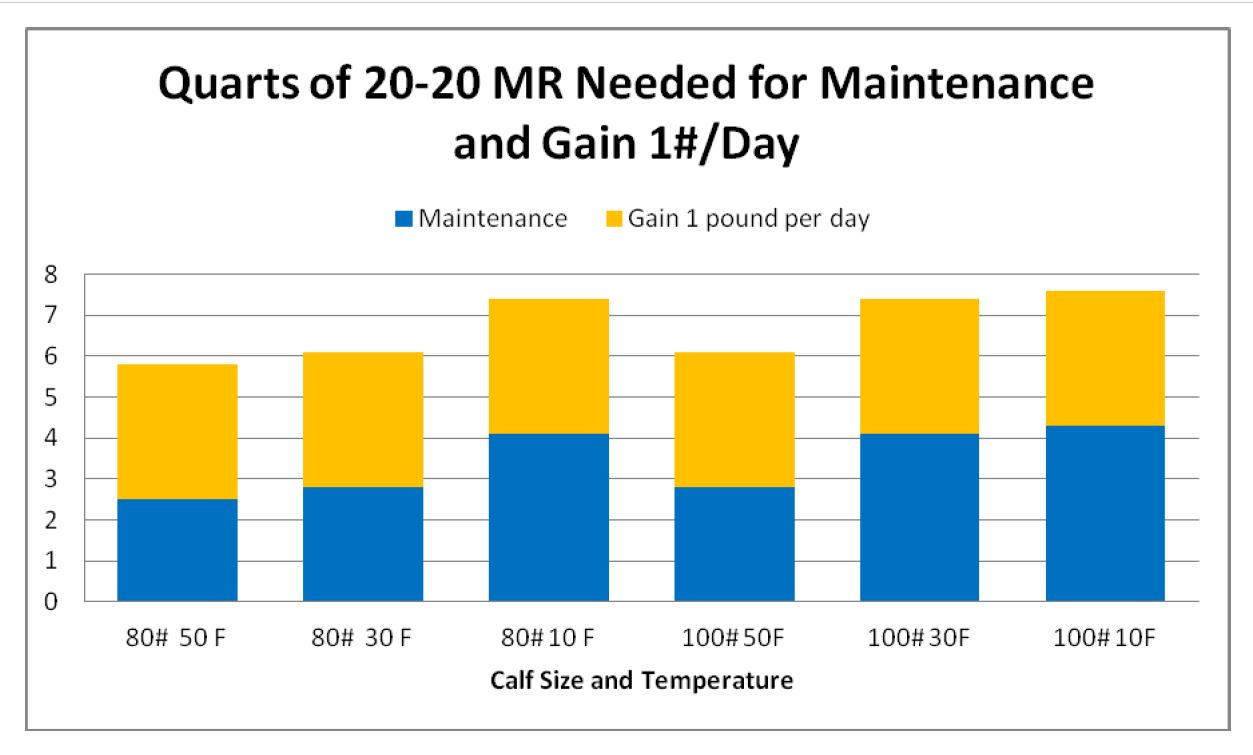
First, annotation that every bit the air temperature goes downward the amount of milk replacer needed for maintenance goes up. The nighttime part of the bar shows how much is needed for maintenance lonely. Three of the night confined that indicate maintenance needs go to a higher place the four-quart line. When fed only four quarts a day these calves are not maintaining their weight. They are losing weight.
2nd, notice that for the aforementioned air temperature the dark confined are taller for the 100-pound calf than for the 80-pound dogie. This ways the larger the calf the greater the amount of free energy she needs to proceed warm, healthy and alive. At ten° the fourscore-pound calf needs 4.1 quarts and the 100-pound calf needs four.9 quarts. That's virtually an extra quart of milk replacer for the larger calf'south maintenance.
Third, yous also want the dogie to grow. The white role of each bar represents the number of quarts of milk replacer needed to proceeds i pound a twenty-four hour period. The tops of all half dozen bars are well above the line marking four quarts daily.
How Can I Feed More?
One way is to feed majority tank milk. Holstein milk has near 25 percent more energy than does 20-20 milk replacer. Bailiwick of jersey milk has about 50 per centum more than free energy. Or, relieve heifer colostrum and second and tertiary milkings from fresh cows.
Mix this in with your milk replacer to boost the energy inexpensively. Another fashion is to mix more 20-xx milk replacer pulverization with the water. Adding two actress ounces of pulverisation per feeding in the same amount of liquid will increase the energy by 25 percentage. If the calves have access to water adding an extra four ounces powder per feeding will add together l percent more energy – only exercise this only if the calves take free-selection water to beverage in addition to their milk.
Some other way is to feed more of the standard mix of milk replacer. While this option works okay with calves large enough to consume more than 4 quarts daily information technology's non every bit effective with pocket-sized calves. Smaller calves tend to eat well i feeding and poorly the next when larger amounts are fed. Also, some producers add commercially prepared fat supplements to boost energy per quart.
Spreadsheet Helps Calculate the Price of Pasteurizing Milk for Calves
A new tool designed to help evaluate the decision to feed pasteurized waste milk is available. This spreadsheet developed past Penn State and Virginia Tech extension educators calculates the cost of owning and operating a calf milk pasteurizer as well as costs to feed milk replacer or whole, saleable milk.
A new tool designed to aid evaluate the determination to feed pasteurized waste matter milk is available. This spreadsheet adult by Penn State and Virginia Tech extension educators calculates the cost of owning and operating a calf milk pasteurizer besides as costs to feed milk replacer or whole, saleable milk. The spreadsheet also compares the nutrients provided past milk replacer, waste milk, and whole milk. All food values can be edited to compare a variety of feeding programs.
The spreadsheet calculates costs and nutrients fed, but does non evaluate calf health or growth for each selection, because many variables other than food intake touch the actual growth and health operation of calves. Additionally, the spreadsheet offers tables that compare the costs of alternatives to feeding pasteurized milk when the supply of waste matter milk is not acceptable to feed all calves. The final components of the spreadsheet are two simple calculators that estimate the supply of and demand for waste product milk and calculate the corporeality of powder to add to waste milk to increase solids or volume. This spreadsheet can exist used when planning for a new pasteurizer and for managing systems already in place.
To download your copy of the Calf Milk Pasteurization Evaluator Spreadsheet, visit das.psu.edu/dairynutrition/calves. A transmission with complete instructions and background data is available at the same location.
This spreadsheet was designed for yous to utilise your own farm data and specifics related to the feeding system changes that you are proposing. To provide an understanding of what the spreadsheet can exercise for you, we have put together some examples of some typical situations. Table 1 shows some of the cardinal inputs for ii situations. Instance i is an HTST system that recycles 66% of the heat generated and is shown for an operation with approximately 750 cows. Example 2 is a batch organization that tin can process up to 30 gal/batch and is shown for a farm of about 200 cows.
In both examples, calves will be fed 1 gal/solar day of pasteurized waste milk, which contains iii.ii% truthful poly peptide and 3.9% fat and is assigned a value of $iii/cwt. This will be compared in our examples to milk replacer containing 20% protein and 20% fat fed at i.25 lb/dogie each day, which costs $75 for a l-lb handbag. In Example ane an electric mixer is used for milk replacer; Instance 2 uses paw-mixed milk replacer due to the smaller number of calves fed. Whole milk in both examples is worth $19.40/cwt, contains 3.0% true protein and iii.5% fat, and would exist fed to calves at 1 gal/day.
Tabular array 2 shows the spreadsheet output comparison the nutrients and feed costs of the three feeds in these examples. On a dry out matter basis, the waste milk provides more poly peptide and fatty than the other options, which would probably result in better growth in calves fed waste matter milk. A high protein, low fat milk replacer would be more than similar to waste milk in the amount of nutrients fed to calves. Information technology is beyond the scope of this spreadsheet to compare growth differences, then growth and health performance of calves are assumed to be equal for the economic comparison. The daily cost of each feed considers the cost on a dry matter footing and the amount of dry matter fed. These values are the aforementioned in our two examples. Waste milk is the cheapest of these feeds when its value is prepare at $iii/cwt.
To download the spreadsheet, visit das.psu.edu/dairynutrition/calves. A manual with complete instructions and background information is bachelor at the same location.
Because the cost of pasteurizing milk is the next footstep. The spreadsheet calculates the cost of owning the equipment (an annual toll that spreads the price over the life of the auto and considers the amount of interest that could be earned if the money was not tied upwardly in the equipment). The pasteurizer besides has operating expenses, including energy costs, cleaning, and extra labor to run the organisation.
In Case 1, owning and operating the HTST motorcar adds about $ane per dogie to the feed cost (the total cost per day is most $46). Mixing the milk replacer adds $0.18 per calf. So the full daily cost for the 44 calves fed pasteurized waste milk is $one.25 per calf. For the remaining half dozen calves, feeding milk replacer would cost $2.06 per calf; feeding whole milk would cost $ii.60 per calf (the spreadsheet assumes that whole milk is pasteurized). Looking at this another way (Table three), the full daily feed cost if all l calves were fed milk replacer would be $95.42. If we fed all 50 calves pasteurized waste material milk, the total daily feed cost would be $59.32. Thus, feeding pasteurized milk would salvage the farm $36.10 per day. Nonetheless, we don't expect to have enough waste matter milk to feed all l calves. This expectation is based on the spreadsheet'due south waste milk supply estimator and assumes typical waste milk volumes found in university field studies. The price of feeding 44 calves pasteurized waste material milk and 6 calves milk replacer is $67.25, which still saves $28.16 per day compared to feeding milk replacer to all calves.
In Example 2, the batch pasteurizer adds $1.55 to $1.70 per calf to the feed cost. The reason for this large increment is the small number of calves beingness fed on this smaller farm. The full daily cost of the batch pasteurizer is under $25, merely that is only spread out over xiii or xv calves. Hot water used to mix the milk replacer adds $0.01 per calf. And so, in this scenario, the total daily cost for the 13 calves fed pasteurized waste milk is $ane.95 per calf. For the remaining two calves, feeding milk replacer would toll $ane.89 per dogie; feeding whole milk would cost $3.22 per calf. As shown in Table 4, the total daily feed price if all 15 calves were fed milk replacer would exist $28.32. If nosotros fed all 15 calves pasteurized waste product milk, the full daily feed cost would exist $27.14. So in this case, feeding pasteurized milk would salve the farm $i.18 per day. Merely again, nosotros don't expect to have enough milk to feed all 15 calves. The cost of feeding thirteen calves pasteurized waste matter milk and 2 calves milk replacer is $29.19, which costs $0.87 per day more than feeding milk replacer to all calves.
Proceed in listen that changes in the number of calves and the supply of waste milk can modify your estimation of the toll calculation. For instance, the farm in Example 2 may decide that seasonal fluctuations in the number of calves on milk would allow them to more hands justify this purchase.
Making a direction alter to using a pasteurizer is a complex decision that requires several coordinated changes on the farm. Using a spreadsheet such equally this tin help you make more informed decisions and may prompt you lot to think more advisedly about what system is all-time for yous.
Table ane. This is a summary of the detailed input considered in the spreadsheet calculations.
| Instance ane | Example 2 | |
|---|---|---|
| Pasteurizer blazon | HTST | Batch |
| Buy price and installation cost | $20,000 | $7,350 |
| Capacity | 600 gal/h | 30 gal in 45 min |
| Energy source | Natural gas | Electricity |
| Energy toll | $1.25 per 100 cubic feet | $0.eleven/kwh |
| Actress labor | 1 60 minutes@ $viii/h | 1 hour @ $8/h |
| Times used per 24-hour interval | 2 | 2 |
| Total calves on milk each day | 50 | 15 |
| Calves fed pasteurized waste milk | 44 | 13 |
Tabular array 2. Nutrient and feed toll comparing of liquid feed options
| MILK REPLACER | Waste matter MILK | WHOLE MILK | |
|---|---|---|---|
| Crude protein, % dry out matter | xx.6 | 26.1 | 25.5 |
| Fat, % dry thing | 20.half dozen | xxx.0 | 28.0 |
| Toll per lb of dry matter | $ane.55 | $0.23 | $1.55 |
| Dry matter fed, lb/twenty-four hour period | 1.21 | 1.12 | 1.08 |
| Crude protein fed, lb/d (DM) | 0.25 | 0.29 | 0.27 |
| Fat fed, lb/d (DM) | 0.25 | 0.34 | 0.30 |
| Daily feed toll, $/dogie (DM) | $1.88 | $0.26 | $1.67 |
Tabular array 3. Comparison of various feeding systems, Instance i HTST pasteurize
| Feeding organization | Total cost $/day | Savings or loss compared to feeding all calves milk replacer |
|---|---|---|
| All milk replacer | $95.42 | |
| All pasteurized waste product milk | $59.32 | $36.10 |
| Pasteurized waste milk and some milk replacer | $67.25 | $28.16 |
| Pasteurized waste milk and some whole milk | $67.78 | $27.64 |
Total of 50 calves; 44 fed waste milk, six fed an culling feed
Table 4. Comparing of various feeding systems, Example ii batch pasteurizer
| Feeding System | Total Toll $/day | Savings or loss compared to feeding all calves milk replacer |
|---|---|---|
| All milk replacer | $28.32 | |
| All pasteurized waste milk | $27.14 | $i.18 |
| Pasteurized waste milk and some milk replacer | $29.19 | -$0.87 |
| Pasteurized waste material milk and some whole milk | $29.96 | -$i.64 |
Total of 15 calves; 13 fed waste product milk, 2 fed an alternative feed Coleen Jones, Research Associate Jud Heinrichs, Professor of Dairy and Beast Science Section of Dairy and Brute Science
Feed More equally the Weather Gets Colder, Or, Seasonally Adjusted Nutrient Intake
Regardless of your growth goals, if you were achieving these goals during the summertime and you keep the same feeding program as the weather gets colder you lot volition non see the same level of success. And then, what to practise now fall months are upon us?
What is "colder?"
Utilise the sweatshirt test. Do y'all need to wear a sweatshirt when working with the calves before 8:00 AM? For about of us that means information technology is in the sixty's. The bottom of the thermoneutral zone for young (less than three weeks onetime) calves is about 60°F.
Beneath 60° these young calves utilise trunk stores of free energy to maintain their core body temperature. Older calves are some other direction grouping. The lesser of their thermoneutral zone is shut to forty°. And, their ration is normally both milk and calf starter grain. In the expanse where I live nighttime temperatures regularly fall below 60° starting in mid-September and keep through May. Average daily temperatures for the Rochester, New York, weather condition station in 2006-vii were below threescore° for shut to 245 days. For a rough approximation of your climate utilise this URL http://www.engr.udayton.edu/weather condition/citylistUS.htm.
How does cold weather impact the amount to feed?
For calves more than iii weeks old and eating calf starter grain the answer is simple. Provide free choice water and calf starter grain. Assuming that you are feeding at least 1 pound of milk replacer pulverisation or iv quarts of whole milk daily, the calf starter grain frequently doubles or even triples the amount of energy available for growth beyond maintenance requirements. It is straightforward. Grain and water. Everyday fifty-fifty when the weather is below freezing. All they want to eat and drinkable. It is a real craven: egg relationship. Water intake drives grain consumption. Grain intake drives water consumption. For young calves that depend on milk or milk replacer for both energy and poly peptide the answer is nearly as simple. Colder weather requires more than dry matter intake to accomplish the same growth goals compared to "summer" conditions.
How much is "more?"
The corporeality of milk replacer or milk dry matter required to meet the maintenance requirements of calves at varying temperatures. The calculations assume 2.45 mcal ME per lb. dry out matter.
| Bodyweight (pounds) | 68°F | l°F | 32°F | fifteen°F | 5°F | -5°F | -20°F |
|---|---|---|---|---|---|---|---|
| lx lbs | 0.6 | 0.8 | 0.9 | i.0 | 1.1 | 1.2 | 1.four |
| 80 lbs | 0.8 | 0.9 | 1.1 | ane.3 | ane.4 | 1.five | 1.7 |
| 100 lbs | 1.0 | 1.1 | 1.3 | 1.6 | i.7 | 1.viii | two.0 |
| 120 lbs | 1.1 | 1.3 | i.5 | 1.7 | 1.9 | 2.0 | 2.3 |
Annotation that the values in the trunk of the table are dry affair, not equally-fed liquid. This table is all about maintenance needs. Then, permit's look at a 100 pound calf at l degrees. The tabular array value is 1.one pounds of dry matter needed but for maintenance. That is equivalent to viii.viii pounds of milk or milk replacer equally-fed (assumes 12.5 percent dry thing – average value for tank milk and milk replacer mixed 0.v pound pulverisation makes two quarts). That is nigh four.25 quarts. My example 100 pound dogie could exist between five to fifteen days old. She is eating very little dogie starter grain. She is depending almost entirely on milk or milk replacer for both energy and poly peptide.
As long equally the weather stays warm she may very well stay good for you until her grain intake comes up to supply nutrients needed for growing. What if she is unlucky and is born in late fall or winter? If we fail to feed enough to meet both maintenance and growth needs at that place is a good gamble she volition go sick during those critical first three weeks of life. If you desire to exercise some calculations for your calves to provide for maintenance and 1 pound of gain per mean solar day, just add 0.5 pounds of dry matter to the table values. Thus, for the example 100 pound calf at l degrees the required dry affair intake for both maintenance and growth increases from one.1 to 1.six pounds or 6 quarts as-fed milk per day.
Feeding strategies for cold conditions are discussed in several resources. If you go to the Internet site world wide web.atticacows.com check on Calf Facts.
half-dozen/09 Calf Connection: Water: Essential Element for Profitability
By Sam Leadley, DairyBusiness www.dairybusiness.com
What's "normal" water intake? When water is offered complimentary choice to calves starting the second day of life, we expect three major factors to influence consumption:
- Individual animate being variation
- The greater the amount of milk or milk replacer fed, the lower the level of water intake
- The higher the environmental temperature, the higher the level of water intake
On one hand, individual calf variation is a huge factor. You probably have had a calf that started drinking water at 24-hour interval two. Or recall the calf that would not touch water until you drastically cutting back the milk or milk replacer? One study found that even though the boilerplate corporeality drunk was 2.4 quarts daily, the private variation was from none to 19 quarts. So much for "normal."
On the other hand, probably at to the lowest degree two-thirds or even 3-quarters of our calves do fit a pattern. During week 1 there may exist minimal consumption. By week 3, many calves offered complimentary pick water are regularly drinking at least one quart daily.
I study feeding acidified milk replacer gratuitous-pick found that calves would drink a lot of milk and very picayune water. At seven weeks calves were up to 13.six quarts of milk replacer daily and less than i quart of water. For those of us manually feeding calves, the difference between 4 and 6 quarts a day probably won't have much effect on water consumption. With calves in common cold housing, we've all observed how low water intakes fall during subfreezing weather. Jim Quigley, director of dogie operations for American Protein Corp., measured h2o intake with air temperatures between 32 and 95 degrees (See www.calfnotes.com Calfnote #68). An xviii-degree change in temperature from 32 to 50 degrees increased h2o intake by well-nigh 0.4 quarts daily. Merely a much smaller, 9-caste change from 86 to 95 degrees increased intake 0.5 quarts daily. Increases at higher temperatures mean drastically greater increases in water needs than similar temperature changes when it is cool.
Make clean water in clean pails
One common challenge is regularly providing clean liquid water in clean pails. A enquiry project measured the effect of the availability of clean water on growth charge per unit. Researchers assumed that calves would beverage more than water if it was fresh and in a clean container. For preweaned and transition calves they varied the interval at which the water pails were rinsed and cleaned.
In both instances the researchers measured 0.2 pounds per twenty-four hour period departure between clean and "non so clean" water. This supports their assumption that fresh, clean h2o in clean pails and tubs promotes higher growth rates. With college water consumption associated with greater dry matter intake (DMI), the calves gained 0.2 pounds average daily proceeds, or 14%, more than calves with lower intakes. Similar findings came out of a comparison of the placement of h2o and grain pails. When the pails were separated physically or by a barrier there was a 33% increase in h2o consumed and an xviii% improvement in body weight gain per day.
Table ii. H2o touch on starter grain consumption
| Water Feeding Method Gratuitous Choice | No Water | |
|---|---|---|
| Number of calves | xx | 21 |
| Calf starter grain intake (lbs) in first 4 weeks | 25.eight | 17.eight |
| Weight gain (lbs) in first 4 weeks | 18.6 | 11.6 |
| H2o consumed (quarts) in first 4 weeks | 47 | None |
Calves with free choice water consumed 45% more than starter grain than the calves without water.
The biggest benefit to providing complimentary choice h2o to preweaned calves is increased DMI. This translates into a higher rate of gain and indirectly to improved health. In Tabular array 2, we see that calves with costless choice h2o consumed 45% more starter grain than the calves without water.
These "free-option water" calves also gained lx% more weight in the first iv weeks. Estimates are that for efficient feed conversion, calves need to consume at least 4 pounds of h2o for each pound of DMI.
Practical summertime tips
For summer direction many farms keep an extra supply of water pails. A number equal to about 20% of calves on milk makes sense. Then each day of the week, one-fifth of the pails tin can exist replaced with make clean ones and the dirty ones tin be scrubbed for the adjacent day. In five days all the pails take been cleaned. Algae and mold are controlled.
For calves in the weaning process or already weaned, water consumption in hot summer weather is ofttimes very high. Many will drink more than than ten quarts daily. This may be a signal where larger pails may exist added to the hutches or pens. Some farms accept a drove of five-gallon pails that are clipped to the hutches or pens effectually weaning time. These larger pails permit once-a-day watering.
Does H2o Brand a Divergence?
Calving Ease, June 2011
Scours
Nosotros all know that the biggest danger from scours is dehydration of the calf. Thus, we ask, "Will a scouring calf drink h2o?" That sounds like a toll effective manner to continue sick calves hydrated.
Give them all the water they want and they will manage their hydration levels by themselves. As dogie care persons we know that every generalization like the 1 in a higher place has weather. When is it true? When is it false? And so, when volition calves effectively manage their own hydration needs past drinking water?
- They are familiar with the source of h2o; bottle, pail or waterer.
- Water is provided regularly and oftentimes enough so calves expect to observe water. This what we call ad lib or gratuitous selection.
- Calves are not so ill that they are still active, warning and drinking their milk eagerly. I always had the best experience with this strategy feeding water to immature calves that was shut to body temperature (that is, close to 90 to 100°F). Many of my calves five to 15 days old when they had diarrhea would drink three to 4 times the small amount they normally drank. Just to exist on the condom side I usually gave them a feeding of an electrolyte solution also.
Calf starter grain consumption Water and calf starter grain intakes get together. Research done in the U.s.a. showed a 45 percent difference in calf starter consumption in the first 4 weeks betwixt calves with and without free option water.
These calves were all fed the same milk replacer ration. Similar work in England traced h2o availability and dogie starter grain intakes. In add-on this work compared two different milk replacer feeding rates. I had to judge these milk replacer powder feeding rates from the information – about 0.8 pounds per twenty-four hour period for the lower rate and 50 percent more, i.2 pounds per 24-hour interval for the college rate. For each feeding charge per unit 1-one-half of the calves either had free pick water or no water.
For both rations the departure in calf starter grain consumed to weaning was slightly over 1.5 times – that is, nigh 150 percent increment (22 pounds without h2o, 57 pounds with water). Conclusion?Availability of free selection water and college levels of dogie starter grain consumption go together.
Weight gains
The United states of america inquiry feeding costless choice calf starter grain and h2o compared to calf starter grain without water had live weight gains in the offset iv weeks of eighteen.6 and 11.6 pounds respectively. Compare. Calves with costless choice water ate more grain and gained 60 percentage more compared to the calves with the same milk replacer ration but no water. This was in the beginning 4 weeks. The UK inquiry had 2 milk replacer feeding levels where the "water" and "no water" treatments were compared (average daily gain in pounds): Depression milk replacer: no water = 0.7, h2o = 1.two for a 67 percent increase with water. High milk replacer: no water = 0.9, water = 1.four for a 51 pct increase with water.Conclusion? Availability of water and higher average daily weight gains go together. An additional benefit of the higher rates of gain may very well be stronger immunity and meliorate overall wellness. Generally, when I find calf programs with growth rates below 1 pound a solar day when measured at 7 to 8 weeks of historic period I also detect programs with significant wellness bug as well. Regardless of whether or not the low growth rates by themselves really cause the undesirably high treatment rates for scours and pneumonia, the calves take low torso condition and practice not appear thrifty.
Summer h2o feeding needs
Compared to wintertime water consumption (oftentimes only 1 to 2 quarts daily) we anticipate summer intakes to be college. Average summertime drinking rates are around 2 to 3 quarts daily for large brood calves effectually 4 weeks old. Close to weaning effectually 6 or 7 weeks summertime intakes crash-land upwardly to double that amount and more. Once calves are weaned await boilerplate consumption to double again. However, all the enquiry seems to show that we should expect very wide differences amidst calves. Do non be alarmed by rates as low as 2 quarts a day and as high as 12 quarts daily.
References: American Journal of Dairy Scientific discipline 67:2964-2969. James Quigley, "Methods of feeding water" Calf Note #77 accessed May 20,2011 http://www.calfnotes.com/pdffiles/CN077.pdf
Source: https://www.vet.cornell.edu/animal-health-diagnostic-center/programs/nyschap/modules-documents/LiquidFeedManagement
0 Response to "When Should a Baby Calf Start Eating Dry Feed?"
Post a Comment